Grade 7–9Curriculum · Maths: algebra
Algebra Worksheets — Free Printable Practice with Answers
Build algebra skills with fresh worksheets: substitute into expressions, simplify, expand brackets, solve equations and continue number patterns.
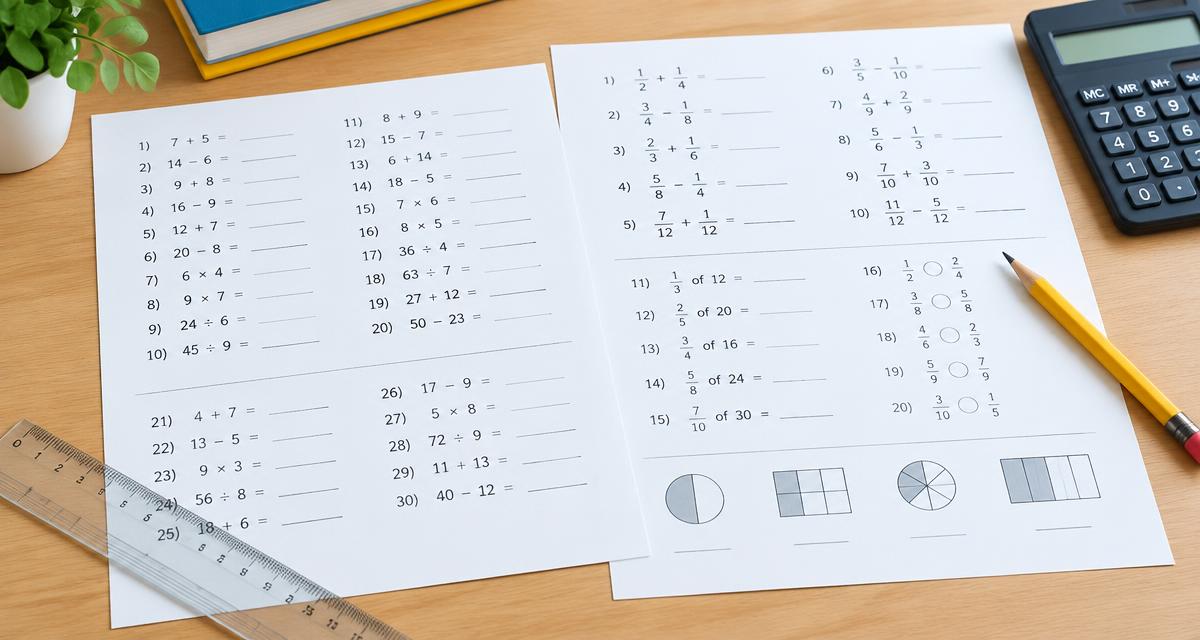
A ready worksheet is waiting below — print it as is or change the settings.
Value of an expression · 12-14 years
Name: ____________________2.A taxi charges 35 kr to start plus 8 kr per km. What does a 10 km ride cost?
4.A cinema card costs 24 kr plus 8 kr per film. Write an expression and find the cost of 7 films.
6.Facts: A delivery costs 10 kr plus 5 kr per kg. Question: What does a 8 kg parcel cost?
8.Facts: A plant is 47 cm tall and grows 13 cm per week. Question: How tall is it after 3 weeks?
10.Facts: A candle is 26 cm tall and a stack of 8 wooden blocks, each 7 cm high, stands next to it. Question: How tall are candle and blocks together?
12.Facts: A delivery costs 21 kr plus 13 kr per kg. Question: What does a 5 kg parcel cost? Answer with the correct unit.
14.A delivery costs 39 kr plus 4 kr per kg. What does a 9 kg parcel cost?
16.Facts: A plant is 13 cm tall and grows 11 cm per week. Question: How tall is it after 5 weeks? Answer with the correct unit.
18.Facts: A taxi charges 29 kr to start plus 4 kr per km. Question: What does a 6 km ride cost?
20.Facts: A candle is 7 cm tall and a stack of 5 wooden blocks, each 8 cm high, stands next to it. Question: How tall are candle and blocks together?
Answer key
- 1. 10
- 2. 115 kr
- 3. -2
- 4. 80 kr
- 5. 23
- 6. 50 kr
- 7. 18
- 8. 86 cm
- 9. 27
- 10. 82 cm
- 11. 7
- 12. 86 kr
- 13. 56
- 14. 75 kr
- 15. -3
- 16. 68 cm
- 17. 20
- 18. 53 kr
- 19. 28
- 20. 47 cm
Created with WorksheetMint
How to use the tool
- Choose an algebra exercise type, such as value of an expression or expand brackets.
- Pick age and difficulty; harder levels add negative numbers, squares and two variables.
- Print or save as PDF. “Create New Version” gives new expressions.
About this generator
Algebra is where pupils learn to use letters as numbers, and these worksheets cover the first steps in a clear order. Value of an expression asks pupils to substitute a number for x in expressions like 3x + 4 or x² + 5, which builds the link between arithmetic and algebra. Simplifying expressions trains collecting like terms, first with one variable and then with both x and y. Expanding brackets practises the distributive law, including negative factors and x(x + 3) at the higher levels. Equations use the balance method, and number patterns ask pupils to find the rule and continue arithmetic and geometric sequences. Word problems show algebra in action, for example a delivery price per kilo, a savings plan that grows every week, or tile patterns where each figure needs more tiles, and the answer key includes units such as kr, cm or tiles. All answers are calculated by the website and each new version is unique.
Popular uses
- First lessons with letters as numbers
- Collecting like terms and expanding brackets
- Pattern spotting and sequences
- Revision and homework with answer key
Plan a useful printable
Start with one clear learning goal and choose only the settings that support it. A short, focused sheet is often easier to explain, complete and review than a crowded page. The live preview makes it possible to check spacing, task count and difficulty before paper is used. Create another version when a class needs the same skill with different content.
Adapt it to the learner
Use fewer items, larger writing areas and familiar content for beginners. Increase the amount, range or complexity gradually for confident learners. Teachers can also combine the printable with oral instructions, pair work or a short follow-up discussion. Because every page is customizable, the same activity can support a warm-up, independent practice, homework or revision.
Print clearly and reuse
Choose A4 or US Letter to match the printer, then print at 100 percent whenever exact spacing matters. The PDF option uses the browser print dialog and creates a clean file for later use. Generated content is prepared in the browser, requires no pupil account and has no watermark. Review every sheet before sharing it, especially when you add your own words or text.
More math worksheets by topic
- Percentage worksheets
- Fraction worksheets
- Equation worksheets
- Decimal worksheets
- Time worksheets
- Area and perimeter worksheets
- Statistics worksheets
- Division worksheets
- Subtraction worksheets
- Volume worksheets
- Unit conversion worksheets
- Mean and median worksheets
- Pythagorean theorem worksheets
- Linear function worksheets
- Proportion worksheets
- Interest worksheets
- Exponent and square root worksheets
- Systems of equations worksheets
- Mixed maths review (ages 14–16)
- Math worksheets grade 1
- Math worksheets grade 2
- Math worksheets grade 3
- Math worksheets ages 8–10 (grades 2–4)
- Math worksheets ages 10–12 (grades 4–6)
- Math worksheets ages 12–14 (grades 6–8)
- Math worksheets ages 14–16 (grades 8–10)
- Weekly math worksheet
Frequently asked questions
- What does it mean to simplify an expression?
- Collect like terms: 3x + 2 + 4x − 5 becomes 7x − 3.
- How do I expand brackets?
- Multiply every term inside the bracket by the factor outside: 4(2x − 3) = 8x − 12.
- Which ages are the algebra worksheets for?
- Mainly ages 11–16. Choose 10–12 and easy for a gentle start.